Avalon's ten-year federal authorization for dredging private boat slips expired on December 31, 2024. In August 2025 the borough applied to the U.S. Army Corps of Engineers for a new one. On September 9, 2026, Borough Council adopted Ordinance 913-2026, which sets up the local side of the system: contractor licenses, owner permits, fees and enforcement.
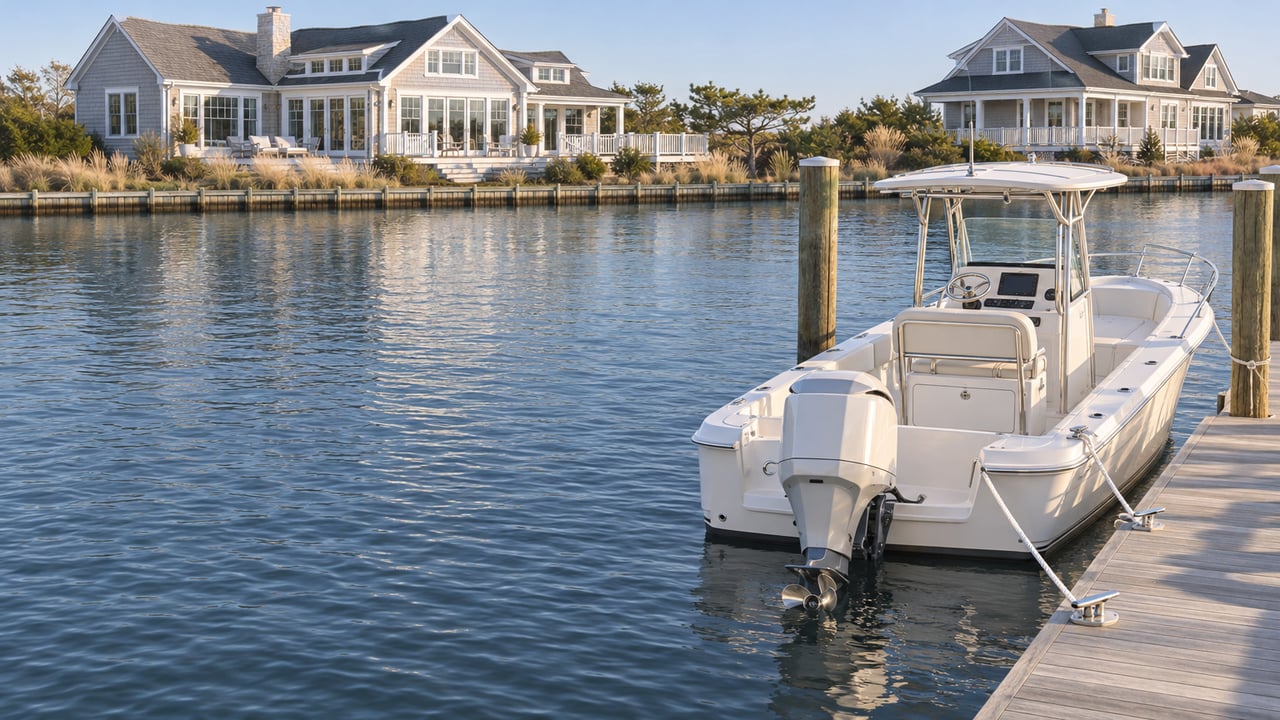
Together these change how anyone shopping for a lagoon or harbor home in Avalon should think about the dock out back. The borough maintains the public channels. The water inside a private slip and its access area belongs to the owner, and so does the cost of digging it out.
The channels are in decent shape. The slips are a separate question.
In late August, the Cape May County Herald reported that a review by borough engineer Thomas Thornton of Mott MacDonald found Avalon's back-bay channels in relatively good shape.
The borough's own federal application describes the water closest to the houses very differently. The Army Corps public notice says the private vessel slips and access channel areas "have become impaired by sediment accumulation, resulting in shoaling conditions" that affect whether recreational boats can safely reach the lagoons and local channels. It also says these areas have historically been kept open by maintenance dredging.
Both findings can be true. A boat can have plenty of water in the channel and still sit on the bottom at its own dock. For a buyer, a healthy public channel tells you very little about one particular slip. The thing that sets a bayfront home's boating value is the depth of that slip at low tide and who is responsible for maintaining it.
One federal permit, many separate decisions
The borough asked the Army Corps for something unusual: one ten-year, borough-wide permit that individual slip owners can use. It doesn't require anyone to act. The notice says dredging "is not mandatory," that each owner who wants it hires and pays a contractor, and that the borough oversees the work through a local permit process. Owners who take part sign documents naming the borough as their agent for the dredging and notify it when work starts and finishes.
The application lists fourteen tidal back-bay channels and man-made lagoons:
- Cornell Harbor
- Pennsylvania Harbor
- Princeton Harbor
- Yale Harbor
- Bluefish Harbor
- Whale Harbor
- Third Avenue Waterway
- Porpoise Lagoon
- Sailfish Lagoon
- Tarpon Lagoon
- Salmon Lagoon
- Long Reach
- Neptune Thorofare
- An unnamed waterway
The specifications set the depth a buyer should keep in mind.
| Element | What the borough's application proposes |
|---|---|
| Permit term | Ten years, dredging as needed to address shoaling |
| Target depth | 5.0 feet below Mean Low Water, plus 1.0 foot of allowable overdredge |
| Side slopes | 3:1 |
| Estimated volume | About 28,500 cubic yards over roughly 5.78 acres |
| Material | Estimated 75% sand, 25% silt |
| Method | Mechanical dredging into watertight scows, loaded directly into sealed trucks |
| Disposal | Upland, at Surrans Soil Replenishment, LLC in Corbin City, Atlantic County |
How the volume was estimated tells you how the program works. The borough based the 28,500-yard figure on dredging data from the previous ten-year permit, including how many slip owners took part, plus an estimate of new participants. The notice says the final volume "will be dependent upon the number of individual vessel slip owners who opt to dredge." The program is built around owners choosing to take part. Two homes on the same lagoon can end up with very different water at their docks because one owner paid to dredge and the other didn't.
The system exists to make that choice easier to act on. When the borough first pursued a town-wide permit, the Seven Mile Times reported the goal: property owners would apply to the borough to dredge rather than to federal or state agencies, which would save them time and money, and the borough would no longer have to seek emergency permits as conditions came up. The paper quoted Mayor Martin Pagliughi:
"The Borough intends to be a model opportunity for other communities to replicate with this new plan, as many coastal communities face similar challenges."
What Ordinance 913-2026 sets up at Borough Hall
The federal permit is the umbrella. Ordinance 913-2026 covers how the work happens on each property. It repeals Avalon's earlier rules for dredging equipment operators and replaces them with two articles.
Article One covers contractors. A dredging contractor needs a borough license, must file an inventory of its equipment for borough inspection, must carry insurance and indemnify the borough, and can face stop-work orders, suspension or revocation, with an appeal process.
Article Two covers individual owners. Owners who want to dredge a private slip apply for a municipal permit. The ordinance's summary lists an application and review process, "fees and other costs and payment of Tidelands Claims if any," rules for how work is done, construction site requirements, stop-work orders issued by the borough's enforcement agent, an appeal procedure and penalties for violations.
The notice of introduction says the ordinance takes effect immediately upon adoption and publication. The notice of adoption records final passage and the mayor's approval on September 9, 2026, with posting on September 11. The full ordinance is available from the Borough Clerk's Office at 3100 Dune Drive.
One detail matters for anyone who looks this up online. The version of Chapter 10 on eCode360 still shows the older dredging-equipment rules, including a $100 annual license fee and set equipment hours. Ordinance 913-2026 repealed and replaced those provisions. The current owner fees and work rules come from the new ordinance and the Clerk's Office.
Where the state fits
New Jersey has its own rules on the same water. The NJDEP dredging page says dredging in coastal waters, including man-made lagoons, is regulated. General Permit 16 covers minor maintenance dredging in man-made lagoons, and work outside the general permits may need an individual permit. The NJDEP Tidelands page explains that dredging which permanently removes sediment from state-owned tidal water can call for a Tidelands license, and the dredging page notes that dredging in a tidelands area at or below mean high water may require one. The Tidelands page also explains that artificial lagoons cut from unclaimed uplands generally aren't tidelands unless an earlier natural-waterway claim covers the area. That's why the borough ordinance says "Tidelands Claims if any." Whether a payment applies depends on the history of the specific lot.
Why this belongs in the purchase, not the punch list
None of this appears on a listing sheet. A bayfront listing shows the dock, the lift and maybe a boat length. It doesn't show the last time the slip was dredged, whether the seller used the old ten-year permit, or what the water looks like at Mean Low Water in late summer.
The market currently gives buyers time to ask. Avalon had 18 closed sales in October 2026, with a median sale price of $3,000,000 and a median of 125 days on market, up from 69 days in September. As of November 6, 2026, there were 64 homes for sale, 25 under contract and 3.6 months of inventory across all price ranges. When homes take about four months to sell, a buyer usually has room to make slip depth part of due diligence.
Questions worth putting to the seller and the borough before you commit to a lagoon or harbor property:
- Which waterway is it on? Check whether the slip sits on one of the fourteen channels and lagoons named in the borough's federal application.
- When was the slip last dredged, and under what permit? The previous borough-wide authorization ran until December 31, 2024. Records from that period show whether the slip has been maintained.
- What is the depth at low tide? The program's target is 5 feet below Mean Low Water plus a foot of overdredge. Compare that with the slip's measured depth and the draft of the boat you plan to keep there.
- What is the status of the borough-wide program today? Ask the borough which permits are in hand, what the Ordinance 913-2026 fees are, and which contractors hold borough licenses.
- Could a Tidelands claim apply? The ordinance contemplates one in some cases, and the NJDEP Tidelands office can explain how claims attach to a particular lot.
Ocean City has dealt with the same split on at least one project. Its bay capital projects page describes a 2015 city contract for Snug Harbor and notes that the work window closed before private owners could dredge their own slips at their own expense. In Avalon, the borough's federal application assigns dredging of private slips and their access-channel areas to individual owners, with borough oversight.
This post is general information, not legal, permitting or financial advice. Before relying on any rule or fee, confirm your property's situation with the Borough of Avalon, NJDEP and your own attorney.
FAQ
Is the Townsend's Inlet dredging this fall part of the private slip program? No. In October the borough announced an agreement with Norfolk Dredging to remove up to 135,800 cubic yards from Townsend's Inlet and place the sand on the north-end beach. Avalon, Sea Isle City, Cape May County and the County Bridge Commission share the cost. It is a separate public project.
Does every owner on a lagoon have to dredge? No. The borough's federal application says dredging by slip owners is not mandatory. Each owner decides and contracts for the work.
Where does the dredged material go? Under the proposal, it goes into sealed trucks and is taken to Surrans Soil Replenishment, LLC in Corbin City for upland disposal.
Has the local program been covered in the news? Yes. The Cape May County Herald reported on August 13, 2026 that Avalon was preparing to announce a borough-wide permit to accommodate private slip dredging.
If you're weighing a home on one of Avalon's harbors or lagoons, or getting ready to sell one, the slip's dredging history belongs in your price conversation. Dorothy Phillips and her team can help you collect that history and put a value on the water at your dock. Request a free home valuation to start.