On file with the New Jersey Department of Environmental Protection earlier this year sits a notice that explains exactly why a Longport renovation deserves more scrutiny than a set of blueprints. A vinyl bulkhead installed under a Waterfront Development Permit issued in December 2018 was supposed to sit 24 inches from the face of the timber bulkhead it replaced. When the as-built survey came back, the new wall sat between 2.67 and 3.47 feet waterward of that line, landing inside a corridor the state had already restricted under a conservation easement. The owner is now seeking a partial release of that restriction, and the matter is running through a 30-day public comment period announced in the March 18, 2026 DEP Bulletin.
A few feet of concrete and vinyl. That is what it took to turn a routine bulkhead replacement into an Appellate Division matter. In a town where every parcel sits inside a mapped flood hazard area, small measurements carry outsized consequences, and nowhere does that show up more plainly than in the number that quietly governs almost every renovation in Longport: 50 percent.
Every Lot in Longport Starts Below Ten
Longport's own floodplain information describes the entire borough as sitting within the A-8 base flood plain, meaning the land is at or below Elevation 10.00. Bordered by the Atlantic Ocean on one side and Risley's Channel on the other, the borough has no high ground to hide behind. Under Chapter 99, the Flood Damage Prevention Ordinance, any new construction or substantial improvement to a residential structure must have its lowest floor, including any basement, elevated at or above the base flood elevation or the advisory base flood elevation, whichever is more restrictive, plus one additional foot of freeboard.
That freeboard requirement is not decorative. It sets the elevation of your first floor, and your first floor elevation sets the ceiling on how tall your house can legally be. Under the borough's zoning code, new and elevated construction is capped at 29 feet 6 inches measured from that finished first floor, with an allowance up to 32 feet if the roof pitch is 4:12 or steeper. Buy a lot with a lower existing first floor and you may inherit a lower ceiling on your entire project before an architect ever picks up a pencil.
The Line Down Atlantic Avenue
Longport's zoning code draws a second line that surprises a lot of buyers moving between blocks: bulkheads are classified as oceanfront or bayfront, and the dividing line between the two designations is Atlantic Avenue itself. Cross that street and the engineering rules change. Oceanfront bulkheads must be timber or concrete, with a finish cap elevation no higher than 13.0 on the mean sea level datum. Bayfront bulkheads, facing Risley's Channel, are held to a much narrower band, built of concrete, steel, timber, or vinyl piling, with a finish cap elevation that cannot dip below 9.75 or rise above 10.25 on the 1988 datum.
Two owners three blocks apart, one facing open ocean and one facing the bay, are working from entirely different armor specifications. A buyer comparing a bayfront rebuild to an oceanfront one is not comparing like to like on bulkhead cost, timeline, or engineering sign-off, even though both addresses share a Longport mailing address and the same flood insurance conversation at the closing table.
A property's flood elevation is not a single number you look up once. It shifts depending on which side of Atlantic Avenue you are standing on, what your permit history shows, and how much of your improvement budget you have already spent.
The Fifty Percent Clock
Here is the mechanism that changes the math on nearly every fixer, teardown-adjacent lot, or long-held family cottage in town. Longport participates in FEMA's Community Rating System, and its higher regulatory standards earn residents a discount on flood insurance premiums. The tradeoff for that discount is stricter enforcement of the National Flood Insurance Program's substantial improvement rule at the local level. According to the borough's own building and construction guidance, homeowners can spend only up to 50 percent of a property's improvement value on renovations within any five-year period before the borough requires the entire structure to be raised to current elevation standards.
That threshold is not a soft guideline enforced at the building inspector's discretion. It is a rolling five-year lookback, which means a kitchen renovation two years ago counts against a bathroom addition you are planning today. An investor who buys a modest 1960s ranch two blocks off the bay with plans to update it in phases, hoping to stay under the radar of a full elevation project, may find that the borough is adding up every permit pulled on that address since well before closing. Cross the 50 percent line and the project stops being a renovation and becomes a house-raising, with all the engineering, cost, and timeline implications that carries.
For a buyer evaluating a value-add property, that threshold is the real underwriting question, more important in many cases than the listing price per square foot. A property that looks like a light cosmetic update on paper can tip into a full elevation project the moment its permit history is added up correctly.
What Gets Recorded at the County, Not Just the Borough
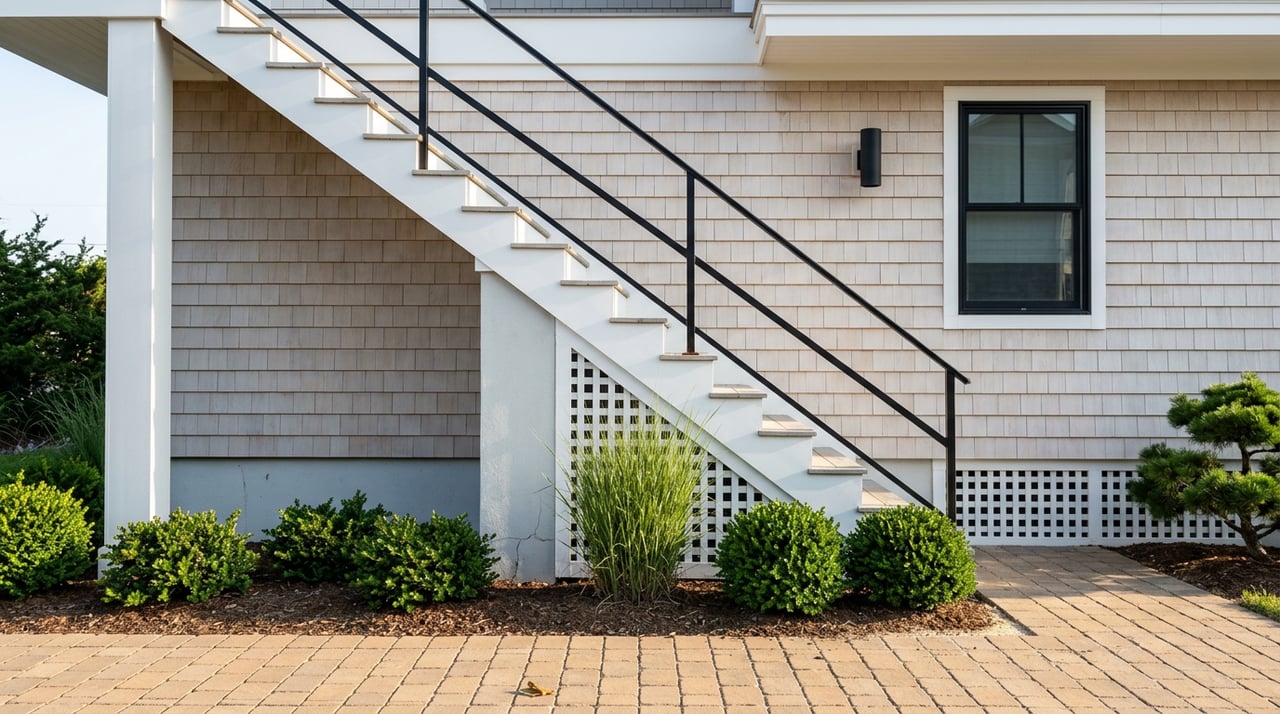
The paperwork trail extends beyond the borough's own construction office. When a permit is issued for a home with any enclosed area below the base flood elevation, the borough requires the property owner to execute a Non-Conversion Agreement. That document states the owner will not convert or alter the enclosed space, typically a ground-level garage or storage area, into finished living space. The form must be notarized before the zoning permit is issued, then brought to the Atlantic County Clerk's office at the Historic County Building on Main Street in Mays Landing for recording, before the applicant returns to Longport's construction office to receive the actual building permit.
That two-office sequence matters to a buyer for a simple reason: a Non-Conversion Agreement runs with the property, not the owner who signed it. If a previous owner finished out a ground-level space in violation of an agreement recorded years earlier, that violation surfaces during due diligence, not before. And because all of Longport sits inside the Special Flood Hazard Area, a Floodplain Development Permit is required for essentially any project on the property, including additions, fences, decks, sheds, and what the borough calls ordinary maintenance. Even an unroofed deck along the Atlantic Ocean or Risley's Channel is capped at a specific elevation, no higher than 11.5 on the NAVD 1988 datum to the landward face of the bulkhead, which means the outdoor living space a buyer pictures on a listing photo has its own elevation ceiling too.
Before You Write an Offer on a Longport Fixer
A short list of what to pull before you get emotionally attached to a renovation plan:
- Request the property's current flood elevation certificate from the borough, tied to its specific block and lot, rather than relying on a general flood zone label from a listing sheet.
- Confirm which side of Atlantic Avenue the bulkhead sits on and whether its cap elevation falls within the oceanfront or bayfront standard, since replacement cost and permitting differ between the two.
- Ask the seller or their agent for a full permit history on the address going back at least five years, not just the most recent renovation, so you can calculate where the property sits against the 50 percent threshold.
- Check whether any Non-Conversion Agreement is recorded against the property at the Atlantic County Clerk's office, and what enclosed space it covers.
- If the lot borders the bay or the ocean directly, get written confirmation of the bulkhead's construction date and whether it was installed under a Waterfront Development Permit, since reconstruction of a legally existing bulkhead follows a different, often simpler permit path than new construction.
- Budget for a licensed marine contractor's inspection of the bulkhead itself before closing, not after, particularly on any lot where the seller has not recently replaced it.
What This Means If You're Buying to Build
For the investor evaluating a teardown or a significant redevelopment, Longport's permitting layers are not a reason to avoid the town. They are the reason a well-advised buyer can move faster than one working from a listing sheet alone. The same March 2026 DEP Bulletin that carried the bulkhead variance notice also included a Coastal Zone Management General Permit reissued to a Longport development entity after an Appellate Division remand sent an earlier approval back for additional review, a reminder that even straightforward removal-and-rebuild projects on this island can pick up a third-party appeal and months of delay.
None of this is a reason to walk away from a Longport project. It is a reason to have someone read the elevation certificate, the permit history, and the bulkhead classification before you write the offer, not after the inspection period has already started running.
FAQ
Does the 50 percent rule reset if I do the work in phases over several years? No. Longport's substantial improvement calculation uses a rolling five-year lookback, so permits from earlier phases count against the current project's share of the property's improvement value.
What is a Non-Conversion Agreement, and why should a buyer care? It is a recorded document restricting how an enclosed space below base flood elevation can be used. It stays attached to the property after a sale, so a buyer inherits both its restrictions and any past violations of it.
Are bulkhead rules the same on the bay side and the ocean side of town? No. Longport's zoning code splits bulkhead standards at Atlantic Avenue, with different materials and elevation caps required for oceanfront versus bayfront construction.
Where can I find a property's official flood elevation before making an offer? Longport's construction office maintains flood elevation certificates by block and lot, and a request there is more reliable for underwriting a renovation than a general flood zone label pulled from a listing.
Longport rewards buyers who do the homework most people skip. If you are evaluating a fixer, a teardown lot, or a long-held family property here and want a clear read on what the flood code actually allows before you commit to a renovation budget, Dorothy Phillips and her team work through exactly this kind of due diligence every day on this stretch of the island. Reach out for a conversation about the property you have in mind.