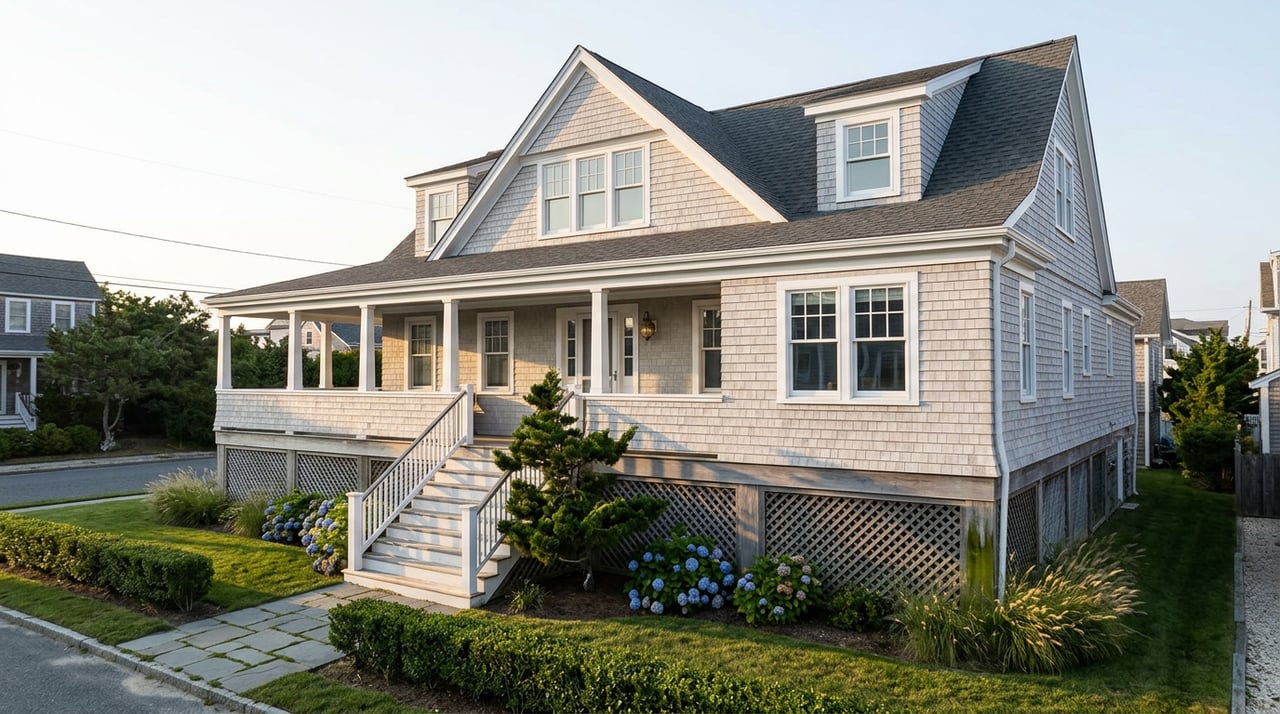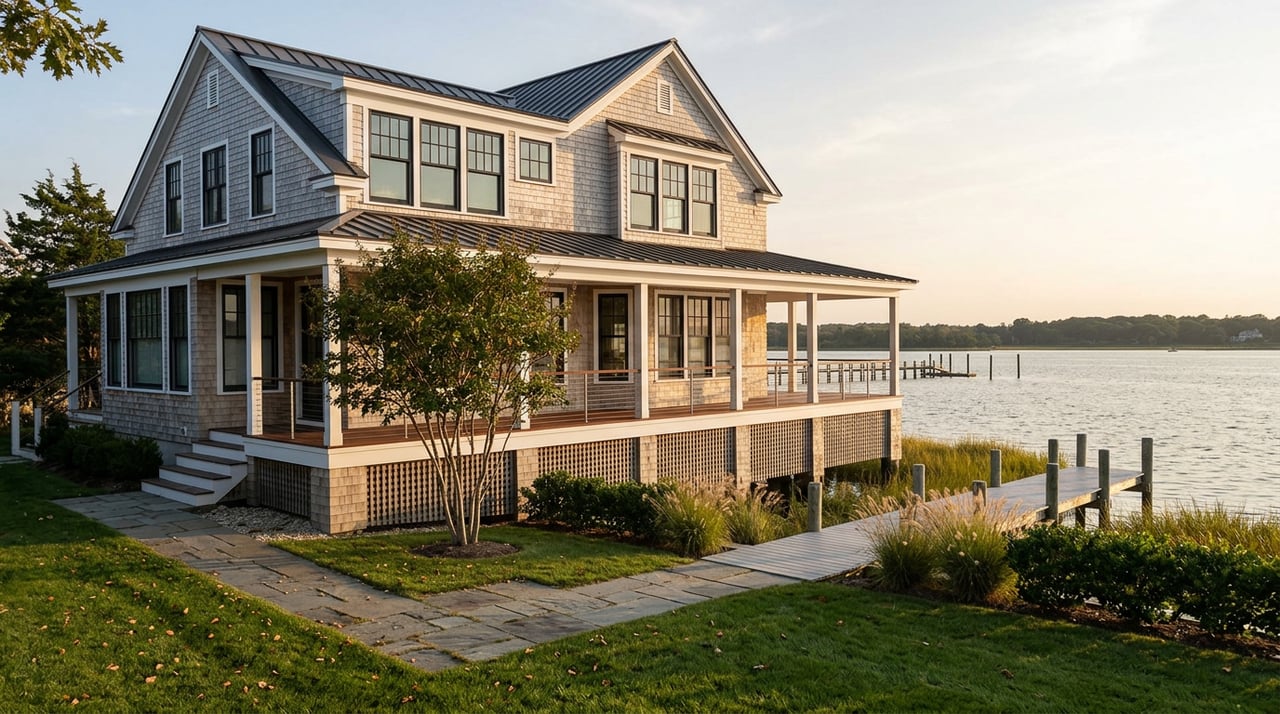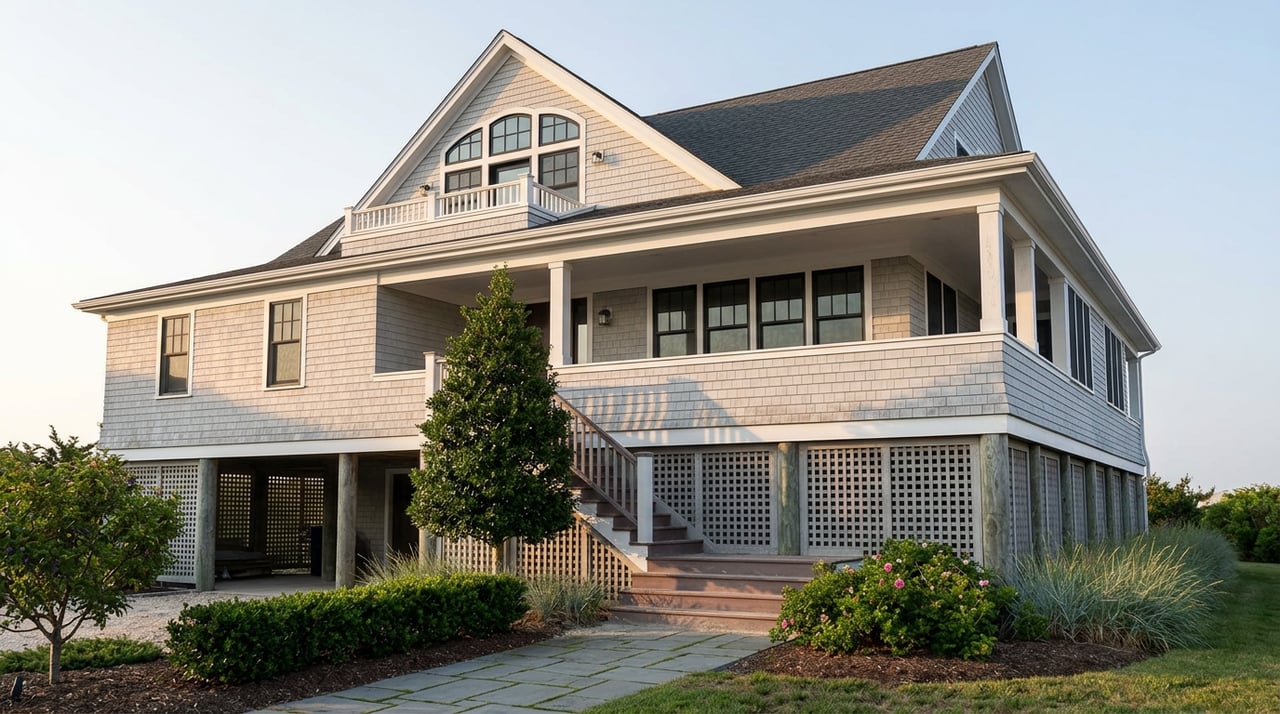
When 481 42nd Street closed for more than $13 million, it set a new high-water mark for a residential sale in Avalon. The address isn't on the ocean. It sits on a canal in the Fingers, the borough's bayfront neighborhood of deep-water lots and private docks tucked behind Dune Drive.
For buyers cross-shopping Avalon against Stone Harbor, Sea Isle City, or the mainland shore towns, the working assumption is usually simple: ocean beats bay, and bay is the consolation prize for a smaller budget. Avalon's own transaction history doesn't support that. The most expensive home ever sold in town faced a canal, not the surf. That's not a fluke. It's a pattern worth understanding before you write an offer on either side of the island.
The Sale That Broke the Script
The home at 481 42nd Street was built by Brandywine Developers, designed by Asher Slaunwhite + Partners, and finished by Megan Gorelick Interiors. It sits on a 60-foot by 155-foot lot, with more than 6,400 square feet of interior space and another 1,000-plus square feet of covered decking, seven bedrooms, seven full baths, and two powder rooms.
It's not an isolated data point. Two other Fingers bayfront sales sit just below it in Avalon's recent sales history: 538 42nd Street closed in 2022 for $8.99 million, and 5 West 32nd Street closed in 2025 for $8 million. Meanwhile, most luxury properties elsewhere in Avalon trade in the $4 million to $6 million range. A home at 12 East 17th Street sold for $4.7 million, and 188 34th Street sold for $5 million.
As of this writing, one oceanfront property at 4202 5th Avenue is listed at $14.995 million. If it closes near ask, it would surpass the Fingers record. It hasn't closed yet. Until it does, the top of Avalon's market belongs to the bay.
| Sale | Location | Status | Price |
|---|---|---|---|
| 481 42nd Street | Fingers (bayfront) | Closed | $13M+ |
| 538 42nd Street | Fingers (bayfront) | Closed, 2022 | $8.99M |
| 5 West 32nd Street | Bayfront | Closed, 2025 | $8M |
| 4202 5th Avenue | Oceanfront | Active listing | $14.995M asking |
| 12 East 17th Street | Town luxury range | Closed | $4.7M |
| 188 34th Street | Town luxury range | Closed | $5M |
Why the Fingers Command What They Command
The Fingers earned its name from the finger-shaped canals cut into the bay side of the island, and the neighborhood trades on things an ocean view can't offer. Lots on Bluefish Harbor sit at the end of quiet cul-de-sacs, with docks built to hold multiple boats. Homes on Princeton Harbor put owners a short walk from town while keeping direct water access at the back door. At the Commodore Bay Club, only four privately owned residences look out toward Cedar Island, and buyers pay for that scarcity as much as the view.
The phrase that shows up again and again in Fingers listings is "fast water," meaning a dock with quick access to open channel rather than a slow paddle through shallow back bay. For a boat owner, that distinction is worth real money. One bayfront listing near Armacost Park even trades on the fact that the parcel directly across the water is a nesting habitat for herons and egrets, land that will never carry a structure. It's the bayside version of the deed restriction that protects an oceanfront view from ever being built out.
None of that shows up in a portal search filtered by "waterfront." It shows up in local knowledge of which canal is deep enough for a center console, which lot backs onto protected marsh, and which street ends put you minutes from the inlet instead of twenty.
The Zone Line Nobody Puts in the Listing Photos
Underneath the lifestyle case sits a construction and insurance mechanism that most buyers never ask about until they're deep into due diligence.
Avalon's flood ordinance treats VE zones and AE zones differently, and the difference isn't cosmetic. In a VE zone, typically the oceanfront and near-oceanfront blocks exposed to wave action, the code measures elevation to the bottom of the lowest horizontal structural member, and construction has to sit on an open foundation such as pilings rather than fill. In an AE zone, more common on the bay side, the code measures to the top of the masonry foundation, support column, or pier, plus three feet of freeboard. That's a meaningfully different (and often less expensive) construction standard.
There's an upside builders have learned to use. One new-construction project near 6th Street, built in a VE zone, was designed with a higher first floor specifically because the zone's elevation requirement created the opportunity for ocean views from both the first and second stories, a feature a standard-elevation home couldn't offer. The same code that raises construction cost also raises what a builder can sell.
But higher elevation and pile foundations cost more to build, and VE-zone flood insurance premiums generally run higher than AE, because the risk model accounts for wave action on top of standing water. A bayfront home in an AE zone, well elevated and well insured, can be a different carrying-cost proposition than an oceanfront home in a VE zone, even before either one goes to closing.
Avalon's Insurance Advantage Most Buyers Never Ask About
Here's a detail that applies to nearly every property in town, regardless of which side of the island it sits on. Avalon participates in FEMA's Community Rating System as a Class 3 community, one of only 13 nationwide at that tier, which currently provides a 35 percent discount on flood insurance premiums for the town's policyholders. Ninety-two percent of Avalon homeowners carry National Flood Insurance Program coverage, according to the borough's own flood program page.
That discount is baked into Avalon's numbers no matter which zone a specific lot sits in, and it's part of why the town's insurance math often looks better than a buyer expects walking in. Flood risk within Avalon also isn't uniform street to street. The borough's own flood information notes that its north end beach blocks typically don't flood during a tidal event but can flood during a heavy rainstorm, while a major tidal event can put water on Dune Drive, Ocean Drive, and the north end bridges. A moderate tidal event may leave most of Dune Drive dry while still affecting Ocean Drive.
The market's ceiling in Avalon isn't set by which side of the island a lot sits on. It's set by what the water lets you build, and what it costs you to insure it once you've built it.
What This Means If You're Comparing Oceanfront to Bayfront
If you're deciding between an oceanfront listing and a Fingers bayfront listing on paper, price per square foot alone will mislead you. Before you compare the two, pull the current FEMA flood zone designation and elevation certificate for each specific address, not a general assumption about "bayfront" or "oceanfront." Ask whether the CRS Class 3 discount already applies to the quoted insurance estimate. Ask what the lot's dock depth is at low tide if boating matters to your use of the property, since "waterfront" on a portal listing says nothing about whether you're facing fast water or a shallow finger.
Avalon's own record sale is proof that the old hierarchy, ocean first, bay second, doesn't hold once you factor in construction standards, insurance economics, and what a specific piece of water actually offers a buyer. The Fingers didn't win on prestige. It won on what the lot, the dock, and the flood zone actually deliver.
FAQ
Does bayfront automatically mean a lower flood risk than oceanfront in Avalon? Not necessarily. Bayfront lots can carry AE or VE designations depending on their proximity to open water and exposure to wave action, particularly near inlets. The zone is address-specific, not neighborhood-wide.
Is every lot in the Fingers zoned AE? No. Zone lines follow FEMA's flood mapping, not neighborhood boundaries, so two lots on the same canal can carry different designations. Pull the flood zone for the specific parcel before assuming.
Does Avalon's CRS discount apply automatically to any home I buy in town? The Class 3 rating applies to National Flood Insurance Program policies written for properties within Avalon, but the exact premium still depends on the individual property's zone, elevation certificate, and construction type. Confirm current terms with a licensed flood insurance agent once you have a specific address.
If you're weighing a Fingers canal lot against an oceanfront block, or trying to make sense of what a flood zone actually means for your carrying costs, that's exactly the kind of comparison worth working through with someone who tracks Avalon block by block. Dorothy Phillips and her team can walk you through the specifics for any address on your list. Reach out for a free home valuation and a straight answer on what the numbers actually mean for you.